A roguelite deckbuilder is a game where you build a deck of cards over a run, and when you fail, you do not simply start over from nothing. You return to a base, spend what you earned on permanent upgrades, and begin the next run genuinely stronger. It combines the card-by-card strategy of a deckbuilder with the run-based structure of a roguelike, but with one crucial softening: progress carries forward as power.
The words "roguelike" and "roguelite" get used loosely, and the difference is easy to muddle. This post sets out what each one actually means, where the line really sits, and why Hungry Horrors happens to be a clean example of both.
What is a deckbuilder?
A deckbuilder is a game where your deck of cards is the thing you improve. You usually start with a small, weak deck, and as you play you add new cards, remove the ones holding you back, and slowly shape something that does real damage when the cards work together.
The skill is not in any single card. It is in the combinations. A card that looks dull on its own can be the centre of your whole strategy once you find the two or three others that set it up. Building toward those combinations is the core of the genre.
The idea comes from card games like Magic: The Gathering and Dominion. Video game deckbuilders took the same principle and wrapped it in a single-player structure you play against the game.
What is a roguelike?
A roguelike is built around runs with permadeath. You start, you play until you finish or die, and when you die, the run is over. You begin the next one fresh, from the baseline, with a new starting deck.
You might unlock new cards or characters into the pool over time, so the range of what can appear grows. But that is different from starting stronger. Each run still begins from scratch. Nothing you built last run is sitting in your deck this run. The randomness of what the game offers, combined with that clean reset, is the point: you cannot lean on accumulated power, only on how well you play the hand in front of you.
Slay the Spire 2 and Balatro are good examples. You get better as a player, and you unlock more possibilities, but every run starts you back at the beginning.
What is a roguelite?
A roguelite keeps the runs and the failure, but softens the reset. When you fail, you return to a hub or base, and you spend what you earned on permanent upgrades that make you start the next run stronger than the last.
That is the real distinction. It is not simply "do you keep anything". It is whether you begin the next run from baseline, or begin it with more power than before. In a roguelite, a bad run still moves you forward, because you bank progress that compounds. Over time the floor rises.
Hades, Loop Hero and Cult of the Lamb are clear examples. You die, you go back, you upgrade, and the next attempt starts from a stronger position. The word is a blend of "roguelike" and "lite", meaning a more forgiving version, and that forgiveness is exactly the carried-over power.
People argue about where the precise line falls, because plenty of games sit somewhere in the middle. The useful test is simple: when you fail and start again, are you stronger than you were, or back at the start?
Why the two pair so well with deckbuilding
Both structures give a deckbuilder what it needs.
A deckbuilder needs a reason to build a fresh deck more than once. Run-based play provides it: every run you build again, usually with different cards on offer, so you are never building the same deck twice.
A deckbuilder also thrives on decisions that matter. Every card offered is a small choice about what your deck becomes, and run-based stakes make those choices count. Whether the game resets you each run or lets you carry power forward, the card-by-card decision-making stays at the heart of it.
How Hungry Horrors does both
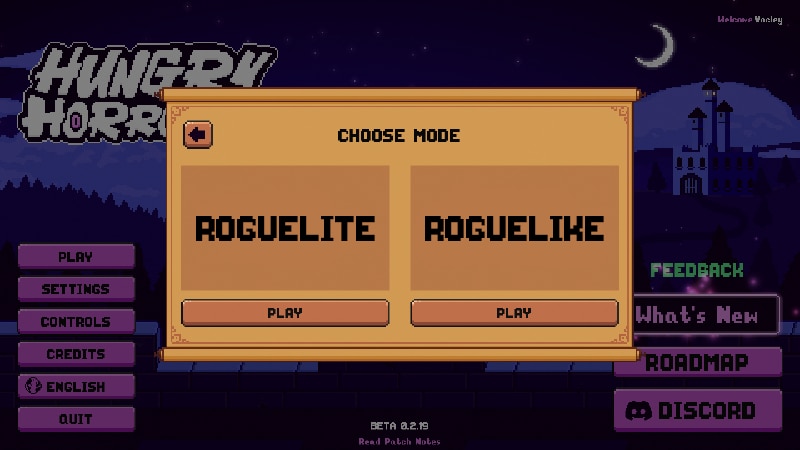
Hungry Horrors is a deckbuilder where you cook instead of fight. You play as a princess feeding monsters from British and Irish folklore, the Horrors, before they reach you and feed on you instead. Your cards are dishes, each Horror has tastes it loves and hates, and you build a deck that can read what is in front of it and cook the right thing. That much is constant. What changes is the structure, because the game offers both.
The Campaign is the roguelite. It is the longer, story-driven mode with characters to meet along the way. When the princess dies, she reappears in the castle kitchen, where she upgrades for the next run: new recipes, new ingredients, new artefacts, and run improvements bought with Scrolls of Taliesin. Each attempt starts stronger than the last, in the true roguelite fashion, so progress compounds even when a run ends badly.
Banquet mode is the roguelike. It is shorter and harder: three acts, permadeath, and a fresh start every time. There is no carried-over power softening the next attempt. It is the mode for players who want the cooking and deckbuilding stripped back to a tight, self-contained test of how well you play.
So the same game gives you both shapes of the genre. Settle into the long roguelite campaign with its story and progression, or take the short, sharp roguelike runs of Banquet mode.
If a deckbuilder where you cook instead of fight sounds like your kind of thing, you can play Hungry Horrors on Steam, where it is in Early Access and updated regularly.
Thanks for reading,
Jerzy